Few things undo a good pair of glasses faster than a wall of white. You step off a warm bus into the cold, lift a mug of tea towards your face, or pull a face covering over your nose, and the world dissolves into fog. It feels random. It isn't.
Fogging is ordinary physics, and it needs three things at once: a cool surface, enough moisture in the air, and a lens that lets that moisture gather into droplets. Remove any one of the three and your vision stays clear. Working out which one is the weak link in your day is usually the difference between fighting the fog and preventing it.
The three conditions that have to line up
Fog on a lens is water, nothing more. Water vapour in the air is invisible; the moment it turns liquid, it turns milky. That switch happens when air is cooled past its dew point. Warm air carries a great deal of vapour, cold air very little, so cooling a patch of air is the quickest way to squeeze water out of it.
Lenses are unusually good at cooling air. Glass and polycarbonate are thin and poor insulators, so a lens left in a cold room reaches room temperature within minutes. Bring warm, damp air anywhere near it and condensation begins almost immediately.
Temperature: why cold lenses fog so fast
The bigger the gap between your lens and the surrounding air, the faster the fog arrives. Come in from a frosty walk and your lenses may be only a degree or two above freezing, while the room is twenty degrees warmer and far wetter. The layer of air touching the lens cools almost instantly, drops below its dew point, and leaves its water behind on the glass.
The reverse happens just as often. Walk out of an air-conditioned shop into a muggy afternoon and your chilled lenses fog on the way out. So do lenses straight from a cold car, a chilly supermarket or a swimming pool changing room. Even a hot drink counts: the steam rising from a mug is warm, saturated air, and a short trip across the rim is all it takes.
Why your breath is the worst offender
Exhaled air leaves your lungs warm and close to saturated with water vapour, which makes your own breath the most reliable fog machine you own. Anything that channels it upwards — a scarf pulled over the nose, a face covering with a loose top edge, a closed helmet visor — traps it right against the lens.
Humidity: the other half of the equation
Humidity decides how bad the fog becomes. On a crisp, dry winter day the air holds very little water, so fog may be a light haze that clears in seconds. In a steamy bathroom, a busy kitchen or a wet bus, there is far more water available and the fog is thick and stubborn.
That is why the same pair of glasses behaves differently from one day to the next, and why fogging is often worst in autumn and winter — not only because lenses are cold, but because we wrap up, breathe into scarves and spend more time in humid, enclosed spaces.
Surface tension: droplets versus a clear film
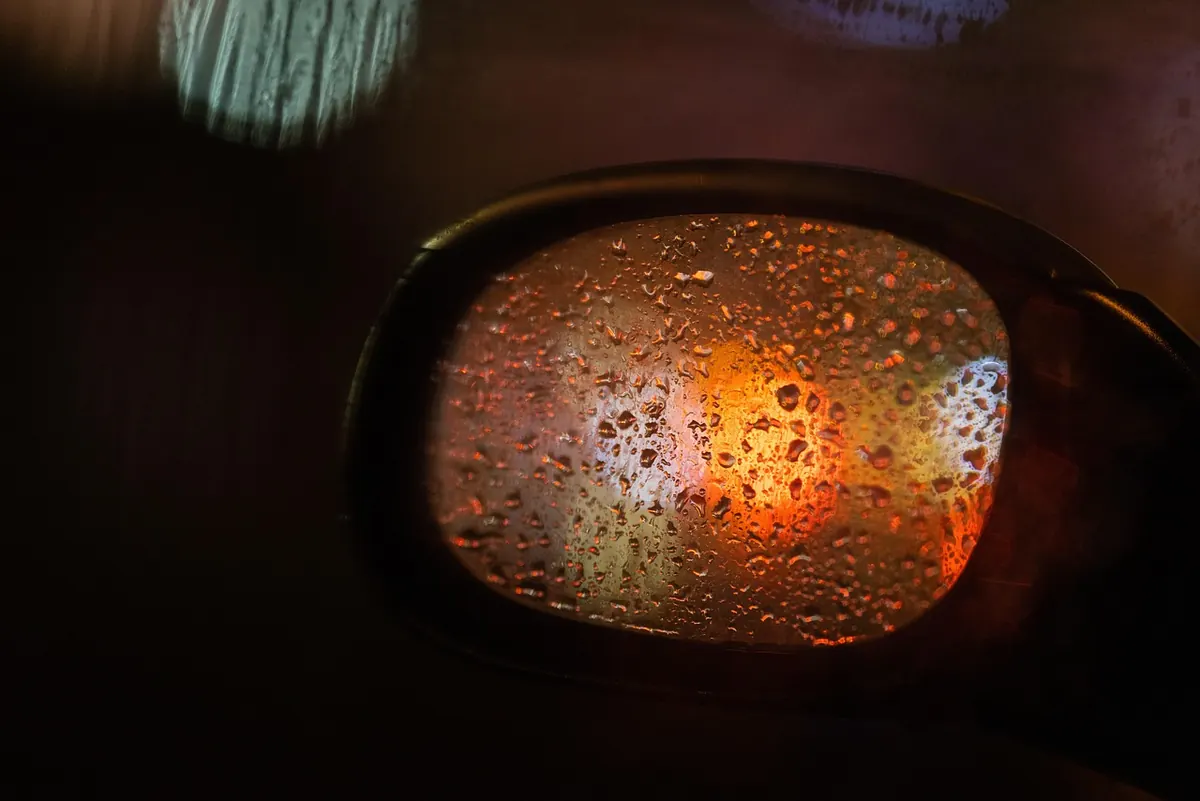
Here is the part most people miss. Water alone is not the problem; how it sits on the lens is. Water molecules pull towards each other more strongly than they pull towards clean glass, so condensation gathers into tiny beads. Each bead has a curved surface that scatters light in every direction, and thousands together read as a grey-white blur.
Spread that same quantity of water as an even, unbroken film and you would barely notice it. A thin film of water is almost as transparent as the lens beneath. That single fact is the basis of every anti-fog treatment.
How anti-fog treatments change the behaviour
Anti-fog products do not stop condensation. They change what the condensed water does next.
- Hydrophilic treatments attract water. Sprays, wipes and dips based on mild surfactants lower the surface tension so droplets flatten and merge into a smooth sheet you can see straight through. This is the most common approach for glasses and goggles.
- Hydrophobic coatings do the opposite: they repel water so it beads and runs off quickly. Excellent in rain, less useful against fog, which is why the two are sometimes combined on sports and safety eyewear.
- Engineered surface textures on some specialist lenses and visors are designed to break up droplets before they grow large enough to blur your view.
Most treatments are temporary. Surfactants are gradually wiped, rinsed or rubbed away, and skin oils speed the process, which is why reapplying according to the instructions matters more than the brand you choose.
Why your glasses fog more than your friend's
Two people can stand in the same doorway and get very different results. A few things tip the balance:
- Frame shape and fit. Large, close-fitting, wrap-style frames hold warm air near the lens and channel your breath across it.
- Lens material and thickness. Different materials warm and cool at different rates, so some lenses fog sooner and clear sooner than others.
- Surface condition. Smears, dust and oil give water somewhere to cling. A properly cleaned lens fogs more evenly and clears faster.
Photo: Kindel Media / Pexels